AP World History 2012-2013
  • Unit 1
    • 1.1.3: Tools and Adaptation>
      • Case Study
      • AGMSPRITE Analysis
    • 1.3.9 & 1.3.2: New Religions & Geographies of Early Civs.>
      • Early Religions>
        • AGMSPRITE Analysis
        • Works Cited
      • The Early Civilizations>
        • Case Study
        • AGMSPRITE Analysis
        • Works Cited
    • 1.1.2: Humans and Fire>
      • 1.1.4: Economic Structures>
        • Case Study
        • AGMSPRITE Analysis
      • Case Study
      • AGMSPRITE Analysis
    • 1.3.6: Arts & Record Keeping>
      • Arts and Artisanship
      • Systems of Recordkeeping
      • Case Study: The Phoenician Alphabet
      • AGMSPRITE Analysis
    • 1.3.1-1.3.3: Early Culture & Systems of Rule>
      • Culture's Effects
      • Systems of Rule
      • Case Study: Hammurabi's Code
      • AGMSPRITE Analysis
    • 1.1-1.4 Early Human Innovation>
      • 1.1.1: Human Patterns of Migration>
        • Case Study
        • AGMSPRITE Analysis
    • 1.2.1-1.2.3: The Climate & The Neolithic Era>
      • Case Study
      • AGMSPRITE Analysis
    • 1.2.5-1.2.6: Reliable Food Sources & Innovation>
      • Case Study - The Plow
      • Works Cited
    • 1.3.1-1.3.2: Pastoralists & Early Architecture>
      • Introduction
      • Monumental Architecture And Urban Planning
      • Pastoralist Weapon Dissemination And Transportation
      • Pastoralist Tools
      • Basic
      • AGMSPRITE Analysis
      • Works Cited
  • Unit 2
    • 2.2.5-2.2.7 Social Hierarchy and Gender Roles>
      • Gender Roles>
        • Case Study
        • AGMSPRITE Analysis
      • Social Hierarchies >
        • AGMSPRITE
    • 2.2.4 Cities>
      • Trade>
        • Trade AGMSPRITE
        • Trade Case Study
      • Religious Rituals>
        • Religious Rituals AGMSPRITE
        • Religious Rituals Case Study
      • Public Administration>
        • Public Administration AGMSPRITE
        • Public Administration Case Study
    • 2.2.2 Orchestration of the Persian and S. Asian Empires>
      • Persia>
        • Imperial Administration and Legal Systems
        • Military Power
        • Trade and Economic Integration and Regulation
        • AGMSPRITE Analysis
      • South Asia>
        • Imperial Administration and Legal Systems
        • Military Power
        • Trade and Economic Integration and Regulation
        • AGMSPRITE Analysis
    • 2.2.2 Orchestration of Rome and China>
      • China>
        • Imperial Administration
        • Military Power
        • Trade and Economics
        • AGMSPRITE Analysis
      • Rome>
        • Imperial Administration
        • Military Power
        • Trade and Economics
        • AGMSPRITE Analysis
    • 2.2.1: Growth of Empires & States>
      • Case Study
      • AGMSPRITE
    • 2.1.6 Cultures Of Second Wave Civilizations>
      • Sculptures
      • Architecture
      • Literature
      • A.G.M.S.P.R.I.T.E
      • Sources
    • 2.1.1: Religions as a Bonding Force>
      • The Basic Gist
      • AGMSPRITE Analysis
      • Case Study
    • 2.1.4 Buddhism and Hinduism Impact on Gender Roles>
      • Buddhism
    • 2.1.2 The Emergence of Religions>
      • Christianity
      • Confucianism
      • Greco-Roman Philosophy
      • Daoism
      • AGMSPRITE
  • Unit 3
    • 3.1.1 Third Wave Global Trade Routes>
      • Basic Gist
      • Case Study
      • AGMSPRITE Analysis
    • 3.1.2 The Impact of trade on emerging trading cities>
      • Basic Gist
      • Case Study
      • AGMSPRITE Analysis
    • 3.1.3. Spread of Islam Through Afro-Eurasia>
      • Basic Gist
      • Case Study
      • AGMSPRITE
    • 3.1.4 Inter-Regional Travelers >
      • The Basic Gist
      • Compare and Contrast
      • AGMSPRITE Analysis
    • 3.1.5. Cultural Interactions and Art>
      • The Basic Gist
      • Cultural Traditions AGMSPRITE
      • Art AGMSPRITE
      • Literature AGMSPRITE
      • Case Study
    • 3.1.6: The Impact of Newly Spread Technologies and Scientific Knowledge>
      • Basic Gist
      • Movement of Gunpowder from East to West
      • Movement of Printing from East to West
      • AGMSPRITE Analysis
    • 3.1.7 Inter-Regional Conflicts>
      • Case Study
      • AGMSPRITE Analysis
  • Unit 4
    • 4.1.1. - Influence of Tools Upon Transoceanic Trade>
      • Basic Gist
      • Case Study
      • AGMSPRITE
    • 4.1.2: Maritime Reconnaissance>
      • Basic Gist
      • AGMSPRITE Analysis
    • 4.1.3 World Economies>
      • Basic Gist
      • AGMSPRITE analysis
      • Case Study
    • 4.1.4 The Colossal Impact of the Colombian Exchange>
      • Basic Gist
      • Case Study on Sugar
      • AGMSPRITE Analysis of the East
      • AGMSPRITE Analysis of the West
    • 4.1.5 Government and the Arts>
      • Case Study
      • AGMSPRITE
    • 4.2.3 Forced Migration of Africans Cause and Effect>
      • Basic Gist
      • Causes of the forced migration of Africans
      • Effects/Developments of the forced migration of Africans
      • AGMSPRITE Analysis
    • 4.3.2 Impact of Technology on state consolidation and imperial expansion>
      • Basic Gist
      • Case Study
      • AGMSPRITE
  • Unit 5
    • 5.3.1 US and Latin American Revolutions >
      • Basic Gist
      • Case Study
      • AGMSPRITE
    • 5.3.2b Hatian Revolution>
      • Basic Gist
      • AGMSPRITE
    • 5.3.2a: Causes and Effects of French Revolution>
      • Causes of the French Revolution
      • Effects of the French Revolution
      • AGMSPRITE
    • 5.3.2c Causes and Effects of the Mexican Revolution>
      • Basic Gist
      • Causes of the Mexican Revolution
      • Effects of the Mexican Revolution
      • AGMSPRITE Analysis
    • 5.3.3: The Winds of Change>
      • Case Study
      • The Conception of Nation-States
      • Nationalism on the Rise
      • AGMSPRITE Analysis
    • 5.3.4 Nationalism and Democracy >
      • Case Study
      • AGMSPRITE
      • 5.3.5 Enlightenment and European Despots>
        • Basic Gist
  • Unit 6
    • War and Peace in a Global Context>
      • Big Gist>
        • WWI vs WWII
      • Case Study
      • AGMSPRITE
    • Changing Economics>
      • Basic Gist
      • AGMSPRITE
      • Case Study
      • Case Study
      • AGMSPRITE
    • Demographic and Environmental Changes>
      • Basic Gist
      • Case Study
      • AGMSPRITE Analysis
    • 20th Century Globalization>
      • Basic Gist
      • Case Study
      • AGMSPRITE
    • Effects of Revolutions on Women>
      • Basic Gist
      • Case Study
      • AGMSPRITE
    • New Patterns of Nationalism >
      • Basic Gist
      • Independence of Vietnam Case Study
      • Effects of Communism Case Study
      • Chinese and Russian Revolutions
      • AGMSPRITE
    • Globalization of Science, technology and culture. >
      • Basic Gist
      • Case Study
      • AGMSPRITE

Persian Military Power
by Ali Kalam

Causes
Picture
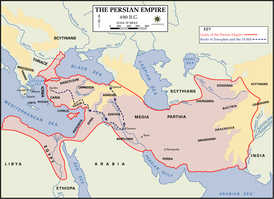
Map of Achaemenid Empire

With its vast land, Persia needed a very powerful, mobile, and adapt military to take and keep control of its many differing regions. There were many threats to the Persian empire that required the empire to create such a strong military, both internal and external. The imperialistic nature of the Persian military led the nation to be very diverse. These nations desired to rule themselves and because of this, the threat of rebellion against the Persian empire existed on every front. Externally, there was always a fight for the balance of power between the proximal empire of Greece. The empire had many seas (Mediterranean sea, Black sea, Persian gulf among others) and differing terrains (Rivers in major cities such as the Tigris and Euphrates river of Babylonia, and many mountains protecting empires, such as the Kackar Moutains in Asia Minor) so the Persian military needed to be powerful on both land and sea. Since the empire needed the military to be strong, they required all men to join.


Navy
Picture
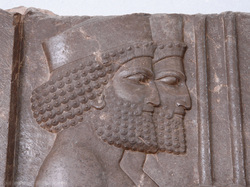
Persian Soldiers
    The Persian navy was founded by Darius the Great and was the first empire to have their own imperial navy. The navy personnel mainly came from the conquered lands being Phoenicians, Egyptians, Cypriots, and Greeks. The navy gave the Persian empire control of the Persian gulf and ability to regulate rivers such as the Tigris and Nile thus helping qualm more rebellions and regulating transport. This brought more unity within in the empire and protection from outside forces thus making a much more stronger empire. The Persian ships created the ability to trade with India through the Persian Gulf and helped stimulate economy between both empires and overall creating a great time of success for the Persian empire. The Persian navy was famous for creating boat bridges across the Tigris to transport forces and combine the power of both land and sea.

Land Military
Picture
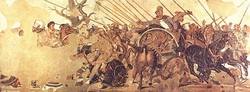
Battle of Issus

    The Persian land military was found by Cyrus the Great and was very segmented with divisions that had their own symbols and colors. Most soldiers carried swords, shields, and daggers, but spearmen and archers were also common. Chariots were not used and were considered obsolete. There was also a group of exactly 10,000 hand-picked special forces elites that are now referred to as immortals, but that name has never been proven. These were the best warriors in the entire military and wore the best gear available. They also used mercenaries from Greece and Nubia for specific smaller tasks. This powerful land army was the driving force behind the massive conquest and keeping of many lands. It was the identity of the Persian empire.

Effects
Picture
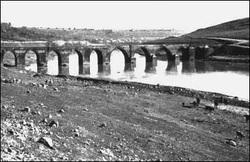
Royal Road ruins
The Persians used their vast land area and powerful military to develop a postal service along with a massive trading route. The Royal Road was a highway that extended throughout the empire and traveled along all major trading routes such as the Silk Road. It served as a trade route and stimulated trade to boost the economy. The Chapar Khaneh traveled alongside the Royal Road and served as a postal route which allowed communication between each area of the vast empire. It created a sense of connection which helped unify the empire as well as allowed for ease in the calming of revolts.

Powered by Create your own unique website with customizable templates.